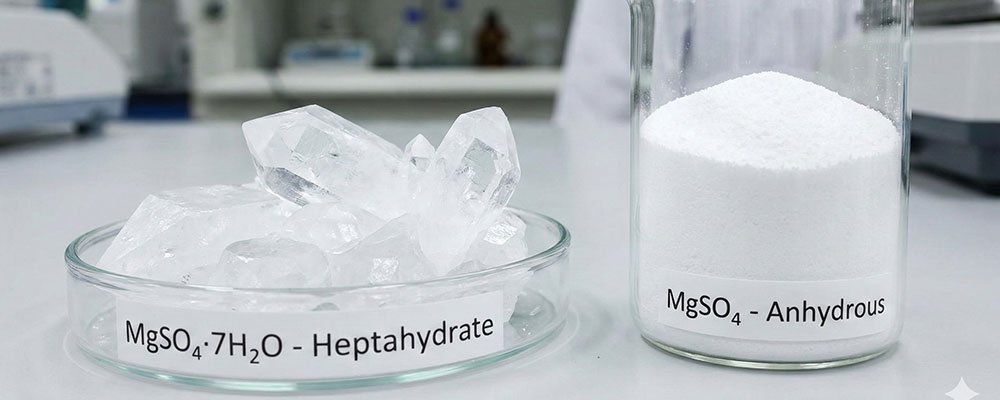

Choosing between magnesium sulfate vs magnesium chloride? Explore our detailed magnesium fertilizer comparison and guide to industrial magnesium sources.
Product Overview
When sourcing bulk chemicals for agriculture, manufacturing, or municipal use, procurement managers often face a critical choice: magnesium sulfate vs magnesium chloride. Both are highly soluble, widely available industrial magnesium sources, but their distinct chemical properties make them suited for entirely different applications.
At WoheChemical, our goal is to help you optimize your chemical supply chain. While we are a primary source factory for premium magnesium sulfate (MgSO4·7H2O and anhydrous), we understand that evaluating alternative magnesium compounds is essential for making the right technical and financial decisions for your facility.
Application Scenarios
Choosing the right compound depends heavily on your industry’s specific requirements regarding sulfur, chloride, and moisture management:
- Agriculture & Fertigation: A core part of any magnesium fertilizer comparison is assessing crop sensitivity. Magnesium sulfate is universally safe and provides essential sulfur. Magnesium chloride provides a higher concentration of magnesium but introduces chlorides, which can be toxic to certain cash crops (like tobacco, potatoes, and some fruits).
- De-Icing & Dust Control: Magnesium chloride (MgCl2) dominates this sector because it is highly hygroscopic (it pulls moisture from the air to keep dirt roads damp) and lowers the freezing point of water more effectively than sulfate.
- Industrial Manufacturing: Magnesium sulfate is preferred in pulp and paper bleaching (for cellulose protection) and textiles, whereas magnesium chloride is often used in the production of cements (Sorel cement) and specialized fireproofing materials.
Product Advantages (Technical Comparison)
To understand which of these industrial magnesium sources is better for your specific application, you must compare their physical behaviors, particularly their hygroscopicity (moisture absorption) and elemental composition.
Quick Comparison Matrix
| Technical Parameter | Magnesium Sulfate (MgSO4·7H2O) | Magnesium Chloride (MgCl2·6H2O) | Application Impact |
| Magnesium (Mg) Content | ~9.8% | ~11.9% | MgCl2 offers slightly more Mg per kg. |
| Secondary Element | Sulfur (Essential nutrient) | Chloride (Can be phytotoxic) | MgSO4 is safer for chloride-sensitive crops. |
| Hygroscopicity | Low to Moderate | Extremely High (Deliquescent) | MgCl2 will dissolve into a puddle if left in open air. |
| Primary Industrial Use | Fertilizers, Feed, Paper, Water Treatment | Dust Control, De-icing, Sorel Cement | Defines your procurement strategy. |
| Storage Difficulty | Standard warehouse conditions | Requires strictly airtight packaging | MgCl2 has a higher risk of ruining in transit. |
For a deeper dive into how chloride affects different plant species, we recommend reading the agricultural guidelines provided by the University of Minnesota Extension on Chloride in Soils. (Rank Math SEO: Authoritative External Link)
Usage Guide / Precautions
Managing Hygroscopicity in Storage
The biggest operational difference between the two chemicals is how they handle ambient moisture.
- Magnesium Sulfate: While it can cake under high pressure and humidity, it generally remains a stable, dry crystal that is easy to handle and repackage.
- Magnesium Chloride: It is deliquescent, meaning it absorbs so much moisture from the atmosphere that it will eventually dissolve into its own liquid. If you are importing MgCl2, ensuring the PE liners are perfectly heat-sealed is non-negotiable, or the cargo will be ruined upon arrival.
Agronomic Precautions: The “Chloride Toxicity” Risk
If you are formulating fertilizers, substituting magnesium sulfate with magnesium chloride to save costs can be a dangerous mistake. While crops like sugar beets and coconuts tolerate chloride well, specialty crops (like citrus, berries, and greenhouse vegetables) will suffer from “leaf burn” and reduced yields if chloride levels build up in the soil or hydroponic system.
FAQ
Q1: In a magnesium fertilizer comparison, why is MgSO4 usually more expensive than MgCl2?
A1: Magnesium sulfate provides two vital macronutrients (Magnesium and Sulfur) without the risk of soil salinization (chloride buildup). The refining process to produce high-purity, fully water-soluble MgSO4·7H2O is also highly controlled, making it a premium agricultural input.
Q2: Can I use magnesium sulfate for road dust control instead of magnesium chloride?
A2: No. Magnesium sulfate is not hygroscopic enough. Magnesium chloride works for dust control because it actively pulls humidity from the air to keep the dust particles heavy and damp.
Q3: Which is better for industrial water treatment?
A3: Magnesium sulfate is generally preferred. Introducing high levels of chlorides into a wastewater stream can violate environmental discharge limits and cause severe corrosion to the treatment plant’s metal infrastructure.