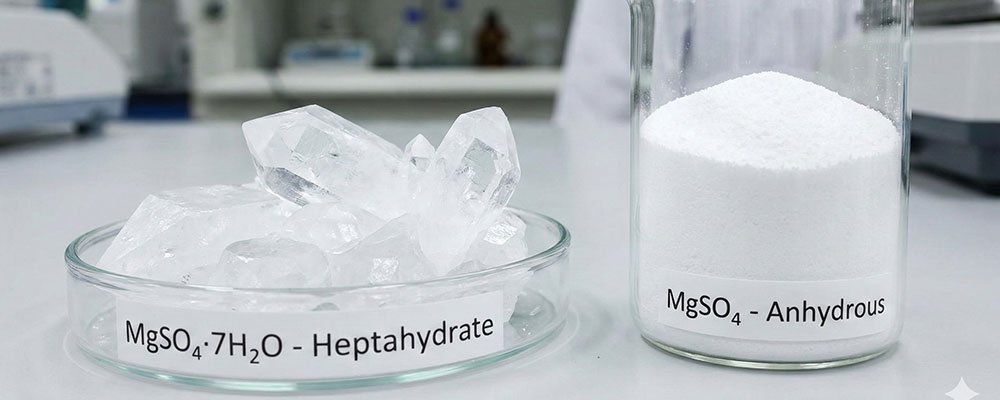

Discover how magnesium sulfate particle size impacts dissolution and dry blending fertilizers. Compare granular vs crystalline MgSO4 mesh size for your factory.
Product Overview
In bulk chemical procurement, achieving 99.5% chemical purity is only half the battle. For production managers and formulation engineers, the physical geometry of the material—specifically the magnesium sulfate particle size—dictates how the product behaves on the factory floor.
Whether you are formulating water-soluble liquid nutrients or manufacturing bulk bulk NPK blends, choosing the wrong MgSO4 mesh size can lead to disastrous manufacturing bottlenecks, from clogged hoppers to severe product segregation in the bag. At WoheChemical, we utilize advanced centrifugation and mechanical sieving technologies to provide precisely graded magnesium sulfate (MgSO4·7H2O and anhydrous), ensuring your raw materials perfectly match your mixing equipment.
(Set Alt Text to: Visual comparison of magnesium sulfate particle size granular vs crystalline forms)
Application Scenarios
Different downstream industries require vastly different particle profiles:
- Clear Liquid Fertilizers & Hydroponics: Formulators require fine, crystalline powders (typically 0.1mm – 1mm) to maximize surface area and guarantee rapid, complete dissolution in cold water mixing tanks.
- Agriculture Bulk Blending: Fertilizer plants require large, uniform granules (typically 2mm – 4mm) to match the size of granular urea and DAP, ensuring even nutrient distribution across the field.
- Personal Care (Epsom Salts): Bath salt brands demand a highly specific, visually appealing medium crystal that absorbs essential oils and fragrances evenly without turning into a dusty paste.
Product Advantages
Partnering with a primary source factory like WoheChemical gives you total control over your physical specifications:
- Custom Sieving Capabilities: We do not offer a “one-size-fits-all” product. We tailor the magnesium sulfate particle size to your exact production requirements, from ultra-fine powders to robust 4mm granules.
- Dust-Free Granules: Our granular products undergo specialized conditioning to eliminate nuisance dust, protecting your workers and keeping your packaging lines clean.
- Consistent Bulk Density: Uniform particle sizing ensures a stable bulk density, meaning your automated volumetric packaging machines will dispense accurate weights every single time.
Usage Guide / Precautions
Granular vs Crystalline Magnesium Sulfate
How do you choose the right physical form for your production line? Here is a breakdown of the two primary categories:
| Specification | Fine Crystalline (0.1 – 1.0 mm) | Granular (2.0 – 4.0 mm) | Best Use Case |
| Surface Area | Very High | Low | High surface area equals faster dissolving. |
| Dissolution Speed | Rapid (Minutes) | Slow (Extended agitation needed) | Fine crystals are mandatory for liquid formulations. |
| Flowability | Moderate (Prone to bridging) | Excellent (Free-flowing) | Granules move smoothly through gravity hoppers. |
| Caking Risk | High (in humid conditions) | Low | Less surface contact between granules reduces caking. |
(Set Alt Text to: Laboratory sieves measuring MgSO4 mesh size and magnesium sulfate particle size distribution)
The Physics of Dry Blending Fertilizers
If your facility produces dry blending fertilizers (bulk NPK blends), matching particle sizes is the single most important quality control metric.
If you mix 3mm granular urea with 0.1mm fine crystalline magnesium sulfate, you will experience a phenomenon called segregation (often referred to as the “Brazil Nut Effect”). During transport and vibration, the smaller magnesium sulfate crystals will sift to the bottom of the bag, while the larger urea granules rise to the top. When the farmer pours the bag into their mechanical spreader, the field will receive an uneven, toxic distribution of nutrients.
To prevent this, you must purchase granular vs crystalline magnesium sulfate that matches the exact mesh size of your other bulk ingredients.
For deep technical insights into preventing segregation in bulk blended fertilizers, we recommend reviewing the guidelines provided by the International Fertilizer Development Center (IFDC).
FAQ
Q1: What does “MgSO4 mesh size” actually mean?
A1: “Mesh” refers to the number of openings per linear inch on a standard laboratory testing sieve. A higher mesh number means smaller holes (finer powder). For example, a 20-mesh screen has smaller openings than a 10-mesh screen.
Q2: Will a smaller magnesium sulfate particle size increase the risk of caking?
A2: Yes. Finer powders have a exponentially larger surface area exposed to ambient humidity. If you order fine crystals for a humid climate, we strongly recommend our premium PE-lined packaging and strict climate control during storage.
Q3: Can WoheChemical provide a specific particle size distribution (PSD) report?
A3: Absolutely. Our QC laboratory can provide a detailed Particle Size Distribution (PSD) curve alongside your standard Certificate of Analysis, guaranteeing the physical consistency of your order.